Open to Public
The Arts, Justice & Wellbeing: A workshop and discussion
Wed, Feb 24.2021
On the Radio!
About the play
-
Antigone by Sophocles
Sophocles’ Antigone is an ancient play about a teenage girl who wishes to bury her brother, Polyneices, who recently died in a brutal civil war. Creon, the new, untested king, has ruled that Polyneices’ body must remain above the earth, and that anyone who breaks this law will be put to death. Antigone openly and intentionally defies his edict, covering her brother’s body with dirt and publicly declaring her allegiance to a higher law, one that transcends that of the state—the law of love. Creon is then forced, by his own political rhetoric, and the by fragile social order that he has barely begun to establish since the civil war, to make an example of his niece, by sentencing her to death. In the process of following through with his own decree, Creon loses everything. At its core, Antigone is a play about what happens when personal conviction and state law clash, raising the question: When everyone is right (or feels justified), how do we avert the violence that will inevitably take place?
Explore Projects
-
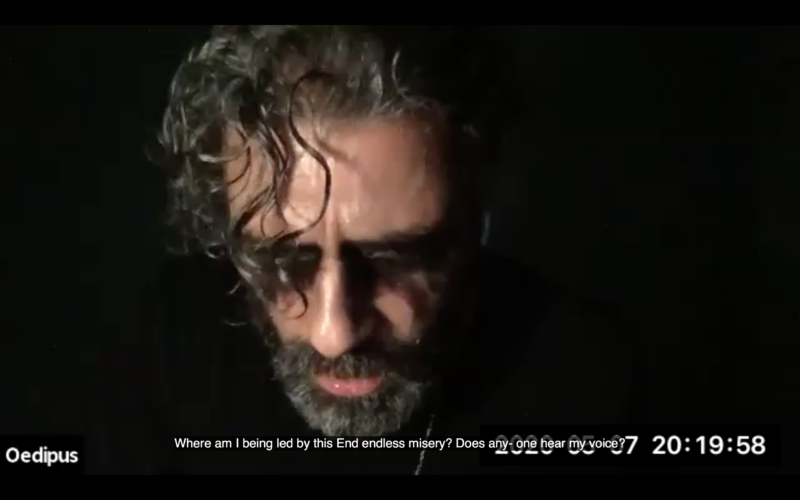 Pandemic & Climate CrisisThe Oedipus Project
The Oedipus Project presents acclaimed actors reading scenes from Sophocles’ Oedipus the King as a catalyst for powerful, constructive, global discussions about the climate crisis, ecological disaster, ethical leadership, and environmental justice. Sophocles’ ancient play, first performed in 429 BC, just after the first wave of a plague that killed nearly one-third of the Athenian population, is a story of arrogant leadership, ignored prophecy, intergenerational curses, and a pestilence and ecological collapse that ravages the archaic city of Thebes. Seen through this lens, Oedipus the King appears to have been a powerful tool for helping Athenians communalize trauma and loss, while interrogating their own complicit role in the suffering, not just of those around them but of generations to come.
-
 War & Mental HealthTheater of War
Rooted in discussions about the invisible and visible wounds of war, the company’s hallmark project is designed to increase awareness of psychological health issues, disseminate information on available resources, and foster greater community cohesion.
-
 Ethics & The Justice SystemTheater of Law
Developed with New York University’s Forum on Law, Culture, & Society, and designed as a professional development program for legal professionals, as well as for the general public, Theater of Law drives conversations about moral justice in the court system. The project is aimed at engaging audiences who have in some way been disenfranchised by the law in constructive, powerful dialogue.